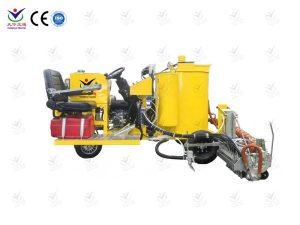
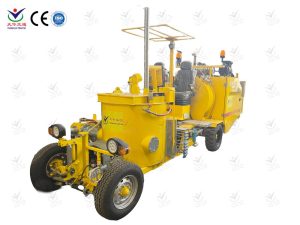
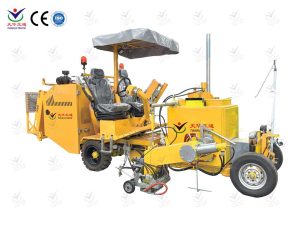
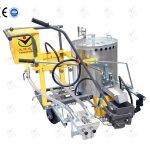
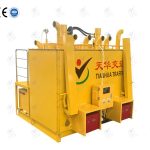
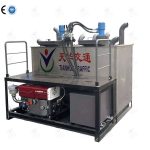
Ride-on road marking machine cost is a decision point for buyers who are balancing upfront investment against daily output, labor efficiency, and long-term operational value. Unlike smaller hand-push machines, ride-on models are typically purchased for larger projects, longer marking distances, and work environments where productivity has a direct effect on project profit. That means cost should never be viewed as a standalone number. It needs to be judged against machine capacity, driving system stability, marking speed, operator comfort, maintenance requirements, and the ability to sustain continuous field performance.
For contractors and distributors, the real question is not simply how much a ride-on road marking machine costs, but what that cost delivers in practical construction terms. A lower-priced machine may seem attractive at first, yet become expensive over time if it creates downtime, inconsistent line quality, excessive fuel use, or slow daily progress. On highways, municipal corridors, airport service roads, industrial parks, and large parking facilities, ride-on equipment is usually chosen because it can cover more distance efficiently while reducing operator fatigue and improving workflow control. In those environments, machine reliability and productivity matter just as much as the purchase price.
Tianhua Traffic helps buyers assess ride-on road marking machine cost from a more practical perspective, focusing on performance, configuration, durability, and commercial suitability rather than price alone. For project procurement, fleet upgrades, or overseas distribution, the right machine should support faster marking, steadier operation, and stronger long-term return on investment. That is where real cost advantage is created.